Kaweka Hospital. The stopbank rebuild after Cyclone Gabrielle. Napier’s newest suburb taking shape at Mission, above Taradale.
If you have watched Hawke’s Bay change over the past nine years, there is a good chance you have been looking at local twin-city planning consultancy Stradegy’s work without knowing it.
Stradegy, with offices in both Hastings and Napier, has quietly become one of the more consequential firms in the region. Not because it builds anything itself, but because almost nothing gets built, protected or restored in Hawke’s Bay without a Stradegy planner or environmental scientist somewhere in the process, shaping where we live, work and play, long before the concrete arrives.
From two planners to an evolving planning firm
Cameron Drury and Roger Wiffin started Stradegy in 2017 with no grand plan beyond getting involved in good projects and doing good work. Both had previously worked within local councils, Cam with Napier City and Hawke’s Bay Regional Council and Roger for Hastings.
“I remember us thinking that if we could get maybe another person to help out, that would be great,” says Cameron, known to almost everyone as Cam.
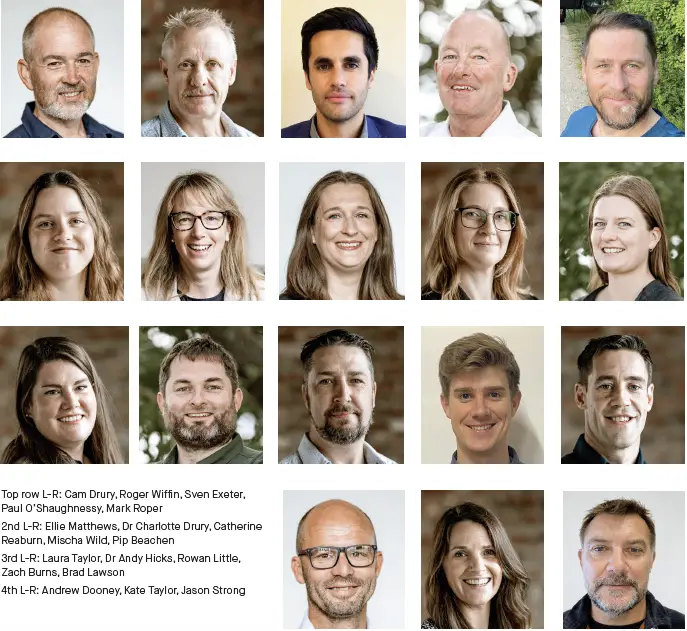
Nine years on, that modest ambition has become Hawke’s Bay’s most respected local planning consultancy, a 20-strong team split deliberately down the middle between the two cities.
The growth was never engineered. It was earned, project by project, through the run of years leading into and out of COVID that put more work in front of a small firm than it could ignore.
“You get more opportunities to do a broader breadth of planning work, and I think it was during that time you just started creating a bigger network,” Cam says.
Good projects built a reputation. Reputation brought people wanting to join. “We never really targeted growth. It kind of just happened.”
What did not happen by accident is what came next. A commercial manager was brought in to bring structure to a fast running firm, and the environmental services team, now covering freshwater ecology, soil contamination and consent compliance and monitoring, was built with intent and has seen Dr Andy Hicks and Jason Strong joining the team to bolster this area of the firm.
“Those areas have been very much part of the planning sector,” Cam explains. National standards for freshwater and contaminated soil are, at their core, planning documents. Stradegy did not diversify. It followed the logic of its own expertise outward.
The rulebook is just the start
Every application a planner touches is bound by district plans, regional rules and national legislation. The difference at Stradegy is what happens inside those boundaries. “Any proposal that comes across your desk, you have the opportunity to add creativity to it,” Cam says.
“You have got to actually contribute to shaping it up, and then present your proposal. There is huge creativity in the way you do that, and the messaging you put across.”
That philosophy was tested hardest in the aftermath of Cyclone Gabrielle. Stradegy has worked alongside Hawke’s Bay Regional Council on the stopbank rebuild, delivered under bespoke Order in Council legislation designed to strip out delay without cutting corners.
“That bespoke piece of legislation is a good example of how it can be done better,” Cam says. “You can break down barriers to get building quicker, and it is possible to get certainty quicker without cutting any corners. All the technical work was still done.”
He rates it as one of the most engaged stakeholder processes the firm has been involved in, with the likes of cultural impact assessments genuinely heard and acted on, not filed and forgotten.
Nine years, no shortage of proof
Kaweka Hospital, the region’s first new private hospital in decades, needed resource consents for a scale of ambition Hawke’s Bay had not attempted before.
The Customs Quay Hospitality Precinct put a four storey mixed-use development on one of Napier’s most visible waterfront sites.
The Mission Special Character Zone, under way since 2021, has Stradegy as lead planner on what will become Napier’s newest suburb, from masterplanning through to subdivision.
The environmental team has its own list: fish salvage work for Councils and contractors, ecological assessments and implementation work on flood schemes, wetland delineation and responses, contaminated site assessments and remediation for industrial and residential developments, consent compliance frameworks for large infrastructure projects and trade waste support.
The developers nobody thanks
Cam is blunt about the perception problem facing the handful of people actually building Hawke’s Bay.
“Those are the people building our cities,” he says of local developers, “and we’re lucky we have them.”
“There is definitely a place for councils and elected members, but it is very much a partnership.”
That conviction extends to how Cam sees the whole region. His picture of an optimal Hawke’s Bay is built on connection, not competition, between Napier, Hastings and Havelock North.
“We need to consider ourselves as one. Otherwise, if one is going well, generally another one is dropping off.”
The same logic applies to the land itself. Cam is adamant the rural sector and its role in food production cannot be treated as scenery to be built around. Growth and production have to be planned together, not traded off against each other.
Nine years after two planners hoped they might land a few decent projects, Stradegy has become one of the steadier hands shaping how Hawke’s Bay actually grows, city by city, catchment by catchment.
As Cam puts it, the job has never really been about ticking boxes. It is “creative problem solving and bringing solutions,” built alongside technical experts, for a region he is clearly still willing to back.