There is a quiet significance to what is happening in the back of the Civil Services office in Onekawa, Napier. Soil samples collected from construction sites across Hawke’s Bay are being tested in an onsite laboratory, the results feeding directly back to engineers and contractors in the field.
It is not glamorous work. But it is exactly the kind of capability that separates a locally-owned consultancy from the multinational firms that have historically dominated this space.
Add a freshly launched brand identity and a new managing director in Brendan Nikolaison, stepping up to take the reins from his father Niels after 31 years of family ownership, and Civil Services is a business worth paying close attention to right now.
The work the company does is largely invisible. It runs beneath your feet, carries your stormwater and wastewater away, feeds you drinking water, and keeps your roads stable. Most people never think about it until something goes wrong. Civil Services has spent 31 years making sure it doesn’t.
From home office to Hawke’s Bay institution
Niels Nikolaison founded Civil Services in 1995 after a career that included project managing infrastructure upgrades for Napier City Council, including Emerson Street. He’d worked in surveying, project management and earthworks in New Zealand and Australia, and when he decided to go out on his own, he did it with a clear head and a practical plan.
An early partnership with Test Labs Wanganui complemented his skills with materials testing capability, and the combination proved durable.
“He bit the bullet and went out on his own,” Brendan says of his father. “I still remember as a kid, him working upstairs at home.”
Over the years, Niels built a reputation for taking local engineers and technicians under his wing, putting several Napier Boys’ High students through the business.
Some went on to Fonterra, major project teams in Christchurch, geotechnical roles overseas. That culture of mentorship and knowledge transfer has remained one of Civil Services’ defining traits.
The long way around
Brendan Nikolaison didn’t plan to come back. He started as a builder in his late teens, developed a practical understanding of how things get constructed, and was heading to Christchurch when Niels called and asked for help for a couple of weeks. That was 15 years ago.
He did a Diploma of Civil Engineering, then went to work for a large international consultancy to get exposure to bigger infrastructure projects and public sector work before returning to the family business. It was valuable experience. It also confirmed something about how he wanted to work.
“You can be very proficient in design software and doing it on a computer,” he says, “but supporting that and taking it through to construction has always been a big driver. In a bigger company, you’d get put in a box. This is your task, stick to it. I wanted to take a project from start to finish. That’s what Civil Services has always done.”
He came back. And he came back better equipped.
Since returning, Brendan has completed a Bachelor of Civil Engineering online and is now a quarter of the way through a Master of Civil Engineering at the University of Auckland, driven partly by the requirements for Chartered Professional Engineer status, and partly by something less transactional.
“I have two young kids. It’s a good example for them later on. A lot of it comes down to self-discipline.”
One-stop, underground
Civil Services operates across four main service areas: civil engineering design, project and construction management, surveying, and laboratory and field quality assurance testing.
About 90% of what the company works on is underground, infrastructure most people never see and rarely think about until something goes wrong.
Recent projects give a feel for the range. The company has been involved in compaction testing on the Hawke’s Bay Expressway, helped restore stop banks after Cyclone Gabrielle, taken the Te Awa subdivision in Napier from early concept through to construction sign-off, and recently completed work on Hastings District Council’s new senior housing development in Flaxmere.
Brendan is pragmatic about the economics of infrastructure. The fix for cost overruns, he says, is usually found at the start of a project, not the end.
“There are ways to spend cents up front to save you a dollar in the long run. Early contractor engagement, identifying the risks before you break ground, making sure you’ve captured everything underground before the excavator arrives. If you take the time to plan and prepare beforehand, it’s a lot, lot better.”
“We can do one piece if that’s what someone needs,” he says. “Just a stormwater solution, just compaction testing, just a topographical survey. But we can also take a project from idea all the way through to the end, and that’s something a lot of clients really value.”
The lab: a game-changing addition
Underpinning all of it is a new onsite soil testing laboratory, and with it, IANZ accreditation that has taken two years to achieve.
The lab completes the one-stop-shop offering Civil Services has been building toward for three decades.
“It’s a full total package,” Brendan says. “You’re not waiting on external factors. You can understand how it’s working on site.”
A new identity, a new chapter
The business recently launched a refreshed brand identity, dropping “HB” to be simply known as Civil Services. A new website and wider marketing push are underway.
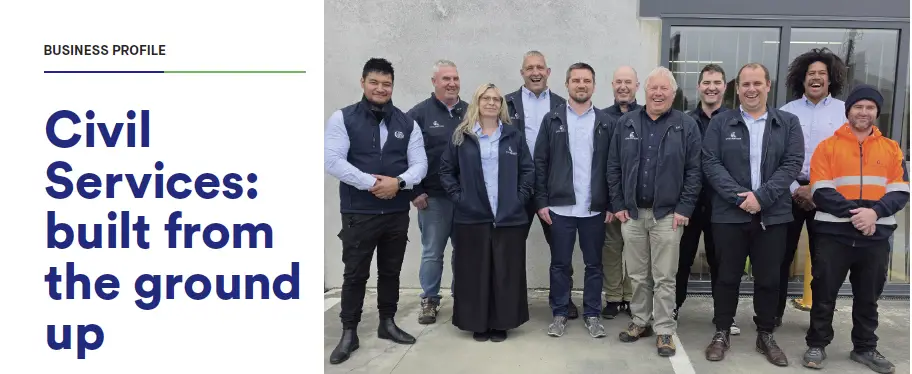
With a team of eleven, including several engineers at different stages of their qualifications and an engineering PhD who provides technical depth across the group, Brendan is building toward the next phase with the same deliberate, layered approach Niels used to build the first one.
A planned overseas break for Niels provided the natural transition point for Brendan to move from acting managing director to assuming the role permanently.
“Think of it like building a cake,” Brendan says. “Start with the base, build each layer, make sure the quality is right all the way up. Get that right and the end result speaks for itself.”
It is, perhaps, an equally good description of the business itself. Thirty-one years of foundations, reputation and technical capability.
A lab that completes the offering. A second generation stepping up with both the practical experience and the academic credentials to take on more complex work. All the layers are now in place.
After 31 years, the founder is ready to step back and enjoy the fruits of what he built. His son is ready to lead. The cake, as they say, is ready to serve.
The missing piece — Civil Services’ soil testing lab
For 30 years, Civil Services conducted field testing on sites across the region.
The missing piece was always the lab. Sending soil samples to external facilities meant waiting on results before work could proceed, a chokehold on the kind of seamless project delivery the company prides itself on.
The addition of an onsite laboratory changes that, and with it, Civil Services has become the first locally owned provider in Hawke’s Bay to achieve IANZ (International Accreditation New Zealand) accreditation for field testing.
Those working in the region’s construction sector have welcomed the added capacity, noting that increased competition benefits project costs and turnaround times across the board. It is a significant development, not just for the business, but for a region that needs capable, accessible infrastructure services to support its economic future.
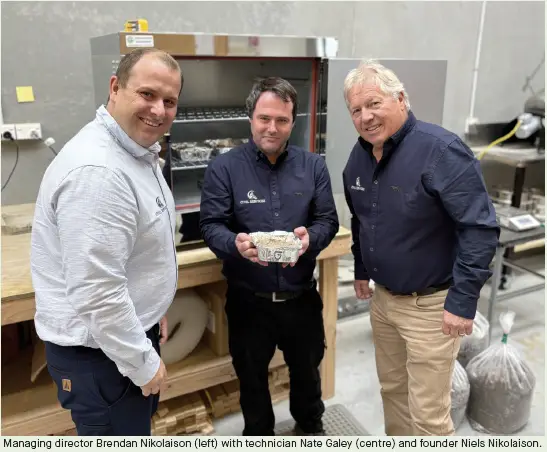
Led by engineering technician Nate Galey, one of the business’s key technical people, the lab now runs compaction curves, moisture content analysis, particle size distribution and Atterberg tests in-house, with results feeding directly back into field operations.
Hawke’s Bay’s soil diversity makes the work genuinely complex. “On the flats you get grey, sandy silt,” Brendan says. “Then you get the hills, limestone, greywacke up in the ranges, and old ocean beds showing seashells. Central Hawke’s Bay has different clays again, and they all react differently to moisture.”
“It’s a full total package,” Brendan says. “You’re not waiting on external factors. You can understand how it’s working on site.”
The lab also uses its own app to produce reports on site in real time, keeping projects moving. “That’s the big step,” Niels says of the accreditation. For a locally owned business competing at the highest level, it is hard to argue otherwise.