The Question I couldn’t answer
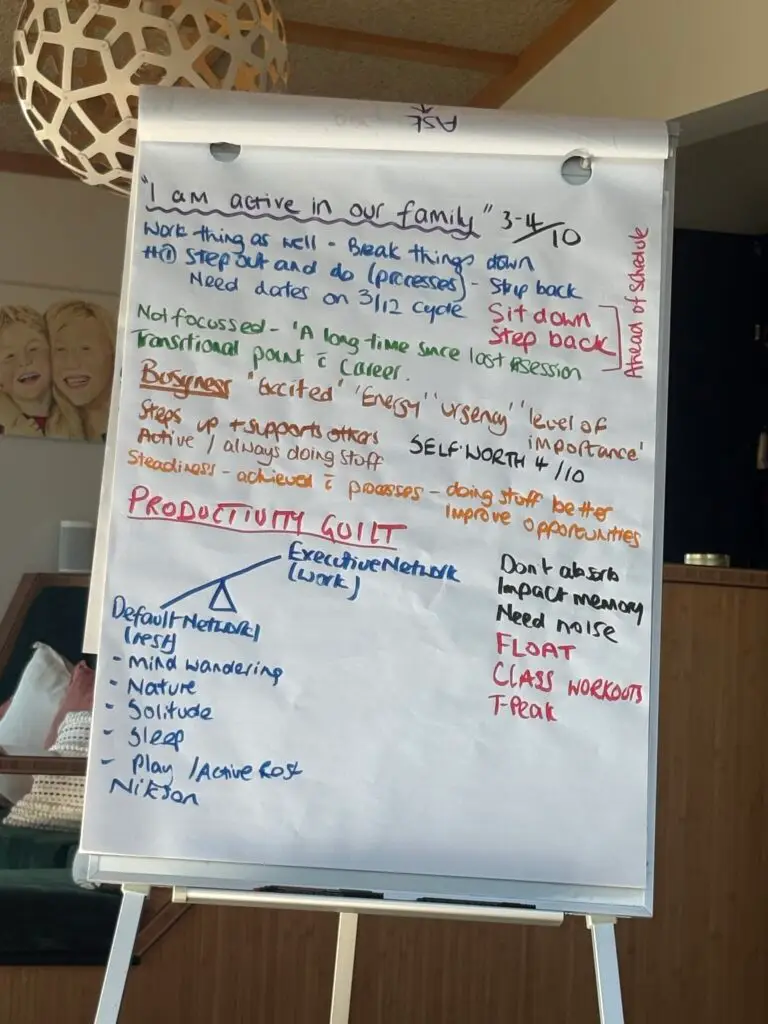
Jo asked me something simple in our last session that turned out to be anything but. What does busyness actually give you? I answered quickly. Excitement, energy, urgency, a sense of importance. Then she took it away. If you strip out the work, the events, the always doing something, who is Damon then?
I did not have a clean answer. I got as far as “someone who steps up” and “always doing stuff” and ran out of road. That is not a comfortable thing to notice about yourself in your fifties. It suggests busyness is not just filling my calendar. It may be doing some of the work of telling me I am worth something.
The honest bit about self-worth
Jo asked me to rate my own self-worth. I put it under half, and acknowledged it was not a new number, just one I had never said out loud. Then she asked what I would feel if one of my daughters rated herself the same way. The concern was instant, no hesitation at all.
That gap says something. What I would find unacceptable in someone I love, I have been quietly living with myself. If I am serious about being more present with the people who matter most, this might be less a family goal and more a self-worth one running underneath it.
Doing nothing feels wrong, and that is the actual problem
Jo challenged me to picture clearing the diary and walking up the Peak with no plan, no destination, no purpose, just walking. My honest answer was that I could not do it. My head would fill with things almost immediately.
That is productivity guilt in plain sight. Exercise is fine because it is doing something. A float is fine because it has a purpose. Just being, with nothing to show for it, is far harder. Jo’s point was that this might be the exact thing worth practising, not because it is relaxing, but because it is uncomfortable in a useful way.
Better systems will only solve half the problem
I have been mapping out clearer processes for Unleashed, the magazine and this column, and that will genuinely help. But Jo pushed on the assumption sitting underneath it. Better systems will not help much if all they do is let me stay switched on more efficiently. You can build an excellent process and still leave zero room for your brain to actually disengage and recover.
What I am taking from that is structure plus space, not structure on its own. Systems should not just help me get more done. Some of them need to deliberately protect time where nothing is meant to get done at all.
Being with yourself, being with your family
This is the connection that has stuck with me most. My goal has been “I am active in our family”. Jo reframed presence as something other than organising activities or starting conversations or launching another family initiative. If my default setting is planning, fixing and moving to the next thing, genuine unstructured presence at home is going to be difficult, because I have not practised sitting still with myself either.
Put plainly, being more active in my family may involve doing less, not more. Sitting, listening, hanging around without an agenda, noticing what is actually happening in the room. No outcome required.
What this means beyond my own lounge room
I think this matters past my own coaching sessions. If I cannot sit comfortably with myself doing nothing, it makes me wonder how well any of us actually sit with someone else who is struggling, rather than rushing to fix, advise or move the conversation along.
Engaging in public comes easier for me. As a trustee of Mates4Life, that is close to the heart of what the programme tries to build, the ability to notice, to ask properly, and to stay in an uncomfortable conversation rather than resolving it too quickly. It took me four years to get around to doing the safety aider course myself. I suspect the same discomfort with sitting still is part of why.
About you
I am doing the public work of Being Damon through this column. It has made me wonder whether the people reading it are doing their own quieter version of it. Not busier. Stiller. Ask yourself what you would answer if someone took the doing away and asked who you are underneath it. It is worth sitting with, even if the honest answer takes a while to arrive.
Being Damon continues.
Being Damon: what the brain does when you finally stop
By Jo Dowley, ReFrame Lab
Coaching someone is one of the great privileges of my work. To be trusted with the conversations that happen beneath the surface, the ones most people never have out loud, is something I never take for granted. It can be tough, scary, and emotional, and it asks something real of the person willing to go there. That is exactly where Damon has gone, and he is making it public.
There is a science to what he is experiencing, and understanding it genuinely changes things. In 2001, neuroscientist Marcus Raichle discovered a network of brain regions, now called the Default Mode Network, that becomes most active not when we are busy and focused, but when we stop. When we let the mind wander, daydream, or sit quietly with nothing particular to do. It switches on when we switch off.
Ever been in the shower and suddenly had the answer to something you had been trying to figure out all week? Or woken at 3am with a thought that felt surprisingly clear? Or had an idea arrive on a walk when you were not even trying? That is your Default Mode Network doing its thing. Not when you are pushing and forcing, but precisely when you are not. The brain is most creative not when we push hardest, but when we finally let go.
I love a book by Dr Joseph Jebelli called The Brain at Rest. It not only helps you understand all of this but gives you real permission to rest your brain and see why we absolutely need to. He writes that our obsession with busyness eventually destroys our brain’s ability to handle being busy in the first place. The evidence is there, and it is hard to argue with.
Most of us have some version of productivity guilt sitting quietly in the background, that nagging sense that rest has to be earned, that stillness is lazy. But what actually activates the default network is beautifully simple: mind wandering, nature, solitude, sleep, play, and doing genuinely nothing at all.. Scheduling that kind of time is not a reward for finishing everything. It is how real creativity, recovery, and good thinking actually happen.
Damon is beginning to experience this for himself. And I think it is the most important part of what he has shared here. I hope his willingness to share it out loud gives someone else permission to do the same.