Being Damon: the leadership journey – Jo Dowley insights
One of the most powerful things about coaching is that people often come in thinking they need help with one thing, only to discover that the real opportunity for change lies somewhere else entirely.
Damon began coaching wanting to improve his focus, better structure his days and weeks, and work out where to direct his energy. Practical and worthwhile areas for goals.
But through coaching, by asking the right questions, stretching his thinking, and exploring what was happening beneath the surface, it became clear that the issue with the greatest potential impact was not about productivity.
It was about how he was showing up at home. Specifically, how present, open, and engaged he was with the people who matter most to him.
This is the power of coaching. Coaching is not about giving advice or telling people what to do. It is about creating the space for people to uncover their own insights, to understand what is really going on, what they truly want, and why it matters.
When people arrive at these insights themselves, the motivation to change becomes far more powerful.
In neuroscience-based coaching, I describe this as a continuous process of:
Reveal: Increasing awareness of what is happening, what patterns are at play, and what matters most.
Reframe: Seeing the situation differently and developing a new perspective on what is possible.
Rewire: Translating insight into repeated actions and experiences that strengthen new neural pathways and support lasting change.
This process is not linear. New insights continue to emerge throughout the journey, each one helping the person refine their thinking, deepen their understanding, and strengthen their commitment to change.
A critical part of this process is getting the goal right.
The most powerful goals are identity-based. They are not simply about doing more or fixing a problem. They reflect the kind of person someone wants to become and the way they want to feel and show up in the parts of life that matter most.
When a goal is emotionally meaningful, it creates energy. It becomes something people are drawn toward, rather than something they feel they should do. That is when change becomes sustainable.
That is the real value of coaching: helping people uncover what matters most, connect deeply to why it matters, and build the awareness, perspective, and habits needed to create lasting change.
— Jo Dowley
Being Damon: an unexpected twist
Two out of ten. That is where I rated myself when my coach asked how present I am in family conversations. Not a throwaway number. A considered one. And I did not see it coming.
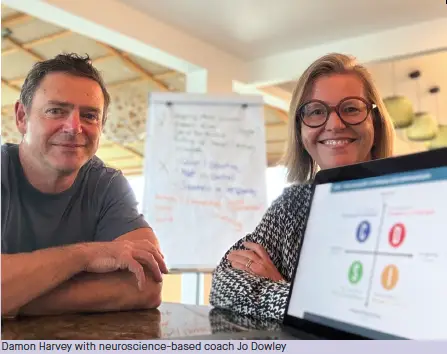
Three sessions in with neuroscience-based coach Jo Dowley, and this is where we have landed. Not on work performance, not on priorities, not on how I structure my days. On relationships. Specifically, who I am at home versus who I am everywhere else.
I walked into this project thinking I needed to get better at focus. What I walked into was something altogether different. And honestly, I was not entirely comfortable going there.
Two Damons
There is a version of me that is, by most accounts, pretty good in a room. Engaged, warm, curious, talkative. I can hold a conversation in a sauna for 24 minutes without coming up for air. I know this because it happened last week and I overstayed my session by four minutes.
Then there is the version of me that comes home.
My family would not hesitate to describe them as two different people. And they would not be wrong. At home, I retreat. I decompress. The conversations happen around me rather than with me.
There is also, it has been pointed out, a grumpiness that surfaces at home that rarely shows up anywhere else. On a rainy Sunday with nowhere to be, I will watch TV in one room while the rest of the household orbits somewhere else, and I will tell myself that is just how I recharge.
When Jo reflected this back to me, she did not dramatise it. She simply said: the data suggests you are not polar opposites at home and at work. But there is a gap. And the gap matters.
The uncomfortable bit
What made this session harder than the previous two was the realisation that this is not new. It is not a product of a busy year or a mayoral campaign or launching O-Studio. It is a pattern that has been in place for a long time.
Jo was careful to draw the line between coaching and counselling. We are not going back. We are not unpacking history. What we are acknowledging is that long held habits are sticky, and that the brain, wired as it is toward self-protection, does not give them up without deliberate effort.
I know that I find it easier to open up with people I am less close to. Strangers in a sauna. A colleague across a table. That is not unusual, apparently. But knowing it is common does not make it easy to sit with.
What I want is different to what I currently do. I want relationships that feel richer. More fun. More connected. More present. I want to be in the room, not just occupying space in it. When Jo asked me to describe what richer would feel like, the words came quickly: fun, loving, connected, secure, involved.
The gap between what I want and what I currently show up as is the work.
We all wear different hats
Part of what I am sitting with is the idea that we are not one personality. We are several. The version of me at work is not a performance, it is genuinely me. But so is the quieter, more withdrawn version at home. Both are Damon. The question is whether the home version of Damon is the one I want to keep defaulting to.
I think most of us would recognise this in ourselves. We suit the room we are in. We read the environment and respond accordingly. The problem is when the room that should feel safest, the one with the people who matter most, is also the room where we go the most quiet.
The goal we landed on
By the end of the session, we had something to work toward. Not a resolution. Not a grand plan. Just a goal.
“I am active in family conversations.”
Simple. A little rough around the edges still. Jo wants me to make it feel more alive, more motivating. But the intent is right. Not to dominate. Not to perform. Not to tick a box with a round-the-table “so how was everyone’s day.” To actually be present. To contribute to whatever is already happening rather than waiting for a conversation that interests me before I bother to show up for it.
The experiment starts small. Asking what someone actually wants to do, rather than defaulting to my own preferences. Staying in the room. Not retreating to the shed when the conversation gets uncomfortable. Noticing when I am physically present but mentally elsewhere, and choosing differently.
No promises about perfect outcomes. That is not how this works. But I did not think I would be writing about relationships in a business magazine either, and here we are.
Being Damon continues.
To talk to Jo – contact her here
Jo Dowley, Neuroscience-Based Coach, ReFrame Lab
jo@reframelab.co.nz | www.reframelab.co.nz | 021 702 049