Most businesses in Hawke’s Bay are seeing AI as simply another tool. The ones pulling ahead are treating it as a capability to build.
If you use AI regularly, you have probably had this moment. You are deep in useful work, and your AI assistant suddenly says you have reached your limit. It feels arbitrary. Yesterday you seemed to get hours of use. Today, a few substantial tasks drain the tank.
That is because AI usage is not measured only by the number of prompts you type. A short question is light work. A long chat with documents, detailed instructions and a polished output is much heavier. Once you understand that, the aim is not to use AI less. It is to use it more deliberately.
Understanding the token economy
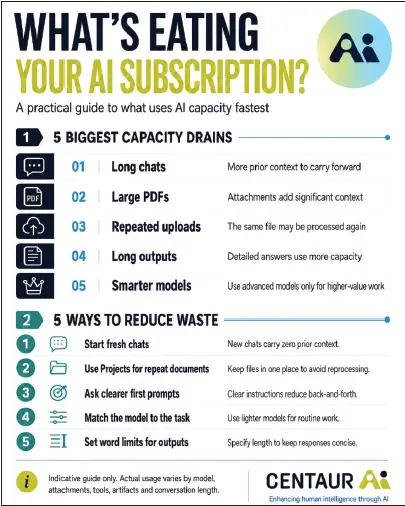
Tokens are the economic currency of AI models. They reflect the cost of compute. As a rough guide, one word is about 1.3 tokens, and subscription tiers are priced on token usage over time. The confusion stems from relative token costs not being visible. Longer chats, larger attachments, tool use, image generation, data analysis and more capable models all draw that budget down faster. That is why limits can feel inconsistent. You may simply be asking AI to carry more context.
Use the right model
Most AI platforms now offer different model tiers. Your choice matters.
Lighter models, such as Claude Haiku, are useful for summaries, extraction, clean-up tasks, simple drafts and routine admin. Mid-tier models, such as Claude Sonnet or Chat 5.5, are the daily workhorse for planning, writing, analysis, customer communication, research support and problem-solving. The most capable models, such as Claude Opus, are best reserved for complex reasoning, strategy, governance, synthesis, board papers and high-value creative thinking.
The mistake is using the most powerful model for every job. That is like paying a senior consultant to sort your inbox. Use a capable default model for most work, switch down for routine tasks, and reserve premium models for deeper judgement.
Design better workflows
The fastest way to waste usage is to keep feeding the model unnecessary context. Start new chats when a conversation becomes long or messy. Ask the AI to summarise the useful context, decisions and next steps, then carry that handover into a fresh chat.
If you use the same strategy document, policy, report or manual repeatedly, place it in a Project, rather than uploading it repeatedly. Different platforms handle this differently, but the principle is the same: structure repeated context efficiently.
Also, be deliberate about output length. Ask for the conclusion only. Request bullet points rather than prose. Set a target word count. Long answers consume capacity too. Output tokens cost roughly five times input tokens, so it matters.
The real value is capability
As AI models become more capable, pricing models will keep evolving, a lot like mobile phone plans did. Expect higher-capability models to command higher prices as the market matures.
The value of an AI subscription is not just access to a model. It is knowing which model to use, how much context to provide, how to frame the task, and how to judge whether the output is good enough to rely on.
That knowledge does not appear automatically when a business buys a subscription. It develops through practice, guidance and AI literacy. The businesses that win with AI have more than subscriptions. They have developed capability that compounds.
Matt Crowther is the co-founder of Centaur AI, where he translates tech-speak into boardroom strategy, AI Literacy training and specialised AI support for Hawke’s Bay businesses. Backed by a Master’s in Technological Futures in AI Adoption for NZ SME’s and years in local senior management, Matt brings a pragmatic approach to AI.