Rare, not risky: why this journey matters
By Jo Dowley, ReFrame Lab
When Damon first suggested we document his journey openly, honestly, fly on the wall style, my first thought was simple: why?
Why would he want to be that transparent?
And almost immediately after, why would I say yes to this?
My brain did what brains often do when something feels unfamiliar and exposed. Doubt. Scepticism. A flicker of anxiety about where this could lead and how it might be perceived.
Then I paused and reframed it.
What if this was not risky, but rare?
What if it was an opportunity to step outside comfort and into curiosity?
What if being a little daring here could create something genuinely useful for others navigating leadership and growth?
So here we are.
We began with the TTI TriMetrix EQ assessment, a science based framework that explores how someone behaves under pressure, what motivates them, and how they recognise and respond emotionally.
Not to label Damon or put him in a box, but to build awareness. Because awareness is always the starting point for meaningful change.
This sits at the heart of my work at ReFrame Lab. I work with leaders who want to better understand their patterns under pressure, how they are experienced by others, and how that impacts decision making, trust and performance, particularly during change or growth.
This journey is not about fixing Damon.
It is about understanding Damon, and seeing what becomes possible from there.
And perhaps more importantly, it is about modelling something many leaders quietly avoid. Looking inward first.
If this sparks a quiet curiosity about how you or your team show up under pressure, then this conversation has already begun to do its job.
Being Damon: now and the future
By Damon Harvey
2025 was a year of change for me.
After nine years as a Hastings District councillor, I made the decision to step away from local government and put my hand up for something bigger. I ran for mayor. I did not win.
That result did not define me, but it did create a pause. Not a dramatic crash, more a quiet moment that prompted uncomfortable questions. Who am I without the title. What actually drives me. And how do I want to show up next.
Alongside council, I have always worn multiple hats. I am part owner and operator of Attn Marketing and PR, now more than 25 years in. I am the publisher and editor of The Profit. I host The Profit Unleashed.
In August last year, my wife Anna and I launched O-Studio Hawke’s Bay, a wellness facility focused on sauna, hot and cold plunging, and float therapy. I also hold governance roles across several organisations. At home, I am a father of five girls, which is the role that matters most.
Individually, none of those roles are unusual. Collectively, they create a life that moves fast and carries weight. What I had not done for a long time was stop and properly examine how I was operating inside all of it.
This project, Being Damon: now and the future, is my attempt to do exactly that, with the guidance of neuroscience-based coach Jo Dowley.
The real starting point
The starting point for this journey was not a deep conversation. It was an assessment.
I completed a TTI TriMetrix EQ assessment. At the time, it felt procedural. A set of questions to work through before the real insight began.
When Jo and I sat down for our first session, she did not reference the report. Instead, she asked simple questions. What energises you. What frustrates you. When are you at your best. When do you feel constrained.
I answered instinctively. It felt conversational and human.
Only after that did Jo reveal the report.
At a high level, it mirrored what I had just described. The language was more formal, but the themes were unmistakable. The assessment was not analysing me. It was reflecting me.
That moment mattered. It set the tone. This was not about being told who I was. It was about seeing myself more clearly.
When the data deepened
From there, the assessment unpacked behavioural tendencies, motivational drivers, emotional intelligence and stress responses. Frameworks such as DISC gave structure to patterns I had recognised but never fully examined.
The report described a high energy, fast moving behavioural style. Comfortable with complexity. Comfortable with ambiguity. Strongly people focused. A natural driver of momentum.
It also highlighted the edges.
A tendency to move quickly and push forward. Frustration when momentum stalls. Strong social regulation, meaning I can lift and guide others, but weaker self regulation when goals are not personally meaningful or externally anchored.
That last insight landed hardest.
In leadership, momentum is often rewarded. Reflection is not always prioritised. Yet without it, strengths can quietly become blind spots.
Naming the emotional layer
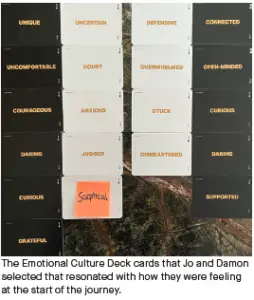
As part of the process, Jo introduced an exercise using The Emotional Culture Deck. Each card carries a single feeling. The question was simple. How do I want to feel, and not feel, during this journey?
We each selected a handful of cards that resonated. The exercise was less about the specific words and more about what they revealed. What we are consciously reaching toward. What we are quietly wary of.
Seeing the two sets laid out side by side was grounding. It highlighted both confidence and discomfort in the room. Growth work is not clinical. It is human. It requires honesty from both people in the conversation.
It reinforced something important. This was not a coach diagnosing a client. It was two professionals stepping deliberately into deeper awareness.
Motivation and momentum
One of the most useful insights from the assessment was around motivation.
I am highly motivated by urgency, challenge and external consequence. Deadlines work for me. Pressure works for me. Clear outcomes work for me.
Where I struggle is the quieter middle. The long runway without obvious reward.
That explains patterns I have recognised for years. Intense bursts of energy leading into big moments, followed by a sense of flatness once they pass. A reliance on urgency to trigger action.
Unexamined, that pattern can limit consistency and presence. It can shape how I lead teams, how I structure work, and even how I show up at home.
Understanding that does not diminish drive. It makes it more deliberate.
Why coaching, and why now
I did not enter this process with a list of things to fix. I came in curious.
Curious about how to be more intentional with my energy. Curious about how I lead without defaulting to pressure. Curious about how I regulate, listen and reset. Curious about how I show up not just at work, but at home.
Jo and I have agreed on a monthly coaching rhythm. Not to add noise, but to slow things down enough to notice patterns, test small changes, reflect honestly and build better habits.
This first story is the baseline.
Over the coming months, I will share what I am working on, what improves, and what does not. Some of it will be neat. Some of it will not.
I am not doing this to become someone else.
I am doing it to understand myself better, use my strengths more deliberately, manage my edges more consciously, and be more present in the roles that matter most.
This is Being Damon. Now, and into the future.