When the rain stopped, what remained was not just wreckage – but a reckoning. Over February 13 and 14 Cyclone Gabrielle didn’t just wreck homes and roads. It ripped the lid off Hawke’s Bay’s vulnerability. In a region where our prosperity depends on what we grow, process and export, losing our transport network didn’t just slow things down – it stopped business in its tracks.
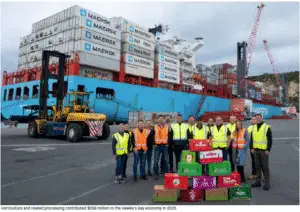
This wasn’t just a natural disaster. It was an economic crisis. Because here, where 31% of our GDP is export-driven – mostly off the back of the primary sector – we’re nothing without movement. Trucks, trains, ports, planes. When those links go down, it doesn’t matter how good your apples are or how fast your meat plant is – you’re stuck. “From the farm or factory gate to the port gate and onto global markets – that movement is essential,” says Napier Port CEO Todd Dawson.
“Without it, Napier Port CEO Todd Dawson costs blow out, quality suffers, and we lose our edge.” Gabrielle made that painfully clear. But it also sparked action. Since then, billions in infrastructure investment have started flowing. Hastings District Council is leading the way on the rebuild, while Central Hawke’s Bay and Wairoa Councils are also rolling out major programmes. This isn’t patchwork – it’s surgery. Follow the Freight If you want to understand the importance of infrastructure in Hawke’s Bay, follow the freight. In 2023, agriculture, forestry and fishing contributed $935.8 million – or 11% – to the region’s GDP. Add in processing and related industries, and the numbers climb fast:
• Horticulture and processing: $558 million (5.4%)
• Meat processing: $518 million (5.0%)
• Forestry and wood products: $371.7 million (3.5%)
• Wool and textiles: $118 million
• Food and beverage processing: $81 million
That’s a freight-heavy economy. And it’s one that depends on a connected system of rural roads, highways, rail lines and the port – working together, without weak links. Take apples, for example. We produce 65% of New Zealand’s pipfruit. That’s over 200,000 tonnes during harvest season, all moving through the region from orchard to coolstore to Napier Port. If one leg of that journey breaks, fruit quality drops and contracts can fall over.
There’s no room for error. Planning Ahead: Building the Engine Room Hastings hasn’t just responded to disruption – it’s been planning for growth. Alongside industry, Hastings District Council has invested heavily in enabling infrastructure, land rezoning and state-of-the-art food processing and manufacturing facilities.
Major general industrial rezonings were undertaken in 2016 and 2017 in Irongate and Omahu Road, adding a net 160 hectares of developable land. Already, 76 hectares have been developed, reinforcing Hastings’ position as the region’s economic engine room.
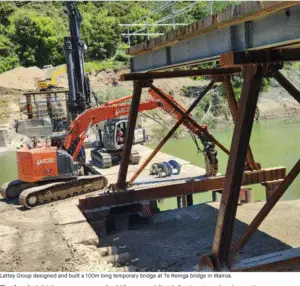
In Irongate alone, more than $500 million has been poured into new fruit processing and storage facilities for companies like Rockit and Sunfruit. Manufacturing plants have followed, including facilities for Lattey Group, BBI, Motus, SCL Civil, Tumu Timbers, TimberSpan, Hawke’s Bay Homes, and a logistics hub for Mainfreight.
Looking further ahead, a new development strategy proposes to identify over 100 hectares of additional supply at Irongate to maintain momentum over the next 30 years. So there’s a lot at stake in keeping the wheels turning from farm gate to market – efficiently, reliably, and at scale. Gabrielle Exposed the Cracks The cyclone didn’t just damage infrastructure – it revealed just how stretched and fragile the system already was. Roads disappeared. Bridges collapsed. Freight got stuck.
The horticulture sector alone lost 35% of its crop value, with around $500 million wiped out across the supply chain. Recovery and replanting costs are expected to reach $920 million, and it could be 2030 before we’re back to pre-Gabrielle production levels.
Roads took an absolute hammering. More than 160 bridges were destroyed or seriously damaged, with 13 bridges needing to be rebuilt as well as six major culverts. Hastings District alone is staring down an $800 million roading rebuild.
Region-wide, the full recovery cost tops $2 billion. “There’s just no getting around it,” says Todd.
“We need strong, smart transport connections. That takes investment, and a hell of a lot more coordination between central and local government.”

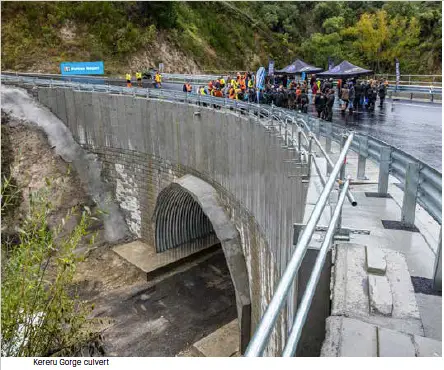
Weak Before the Storm The truth is, Gabrielle didn’t break a perfect system – it smashed one that was already stretched. State Highways 2 and 5, our main links to Palmerston North and Taupō, were already risky, with frequent slips, flooding and rising wear Kereru Gorge culvert from heavier freight volumes. Deferred maintenance only made things worse.
In response, the Tupe Aumoana Hawke’s Bay Regional Freight Distribution Strategy was launched – not just to recover, but to reset. It outlines clear priorities: strengthen SH2, SH50 and SH51, fix rural roads, improve intermodal freight options, and build in resilience. Todd reckons the strategy is solid, but says the pace is too slow.
“We’ve got competing priorities across agencies, and we’re losing time. We know what needs to happen. Let’s get on with it.” He says what’s needed is long-term thinking and collaboration – real partnership between councils, iwi, industry and government.
“If we don’t fix the structural gaps now, we’re setting ourselves up to be vulnerable all over again.” Smarter Rebuild, Not Just Bigger This rebuild isn’t about replacing what we had. It’s about building smarter – for the climate and conditions we now face. And that costs money, more than what’s been allocated so far. Projects like the massive culvert rebuild at Kererū Gorge are designed not just to survive the next big storm, but the next decade of changing conditions. Gavin O’Connor from civil infrastructure firm Tūpore says the cyclone exposed another vulnerability: materials.
“You can’t build bridges without aggregate. And if you don’t have a reliable local source, you’re stuck trucking it in from ages away. That drives up time and cost.” Gavin’s team is investing in better local supply chains. But he’s blunt about the wider issue.
“The funding cycles are all over the place. We’ll have a flurry of work, then nothing. It’s hard to keep skilled people employed with that sort of stop-start planning.” He says the region needs pipeline certainty – not just funding announcements, but actual work flowing at a steady pace. And he’s got strong views on who should get that work. “Give it to local contractors and you keep the money here. You grow skills and capability. If the big multinationals clean up, the money’s gone the second the project’s done.”
Beyond Roads Transport might be the focus, but it’s not the only piece of the infrastructure puzzle. As Ngāti Kahungunu chair Bayden Barber said in The Profit earlier this year, water is just as critical.
“Water management is one of our biggest opportunities. It underpins the future of farming and food production,” said Bayden. Ngāti Kahungunu’s commercial arm – with investments across fishing, forestry, and farming – is now exploring water storage solutions. The Hawke’s Bay Regional Council says the Heretaunga aquifer is already overdrawn, and demand is only going to increase.
This kind of thinking is gaining ground. Infrastructure isn’t about roads or irrigation or flood protection in isolation – it’s how those systems interact. As Pan Pac Managing Director Tony Clifford put it, “Get the infrastructure and regulations right, and business will follow.”

That includes something a lot of people didn’t think much about until last year: stopbanks. The Unsung Infrastructure Gabrielle didn’t just flatten roads and bridges – it blew out the region’s stopbanks. These flood defences stretch 248 kilometres and protect productive land, towns and infrastructure. But during the cyclone, they failed in 30 places, with 5.6km of serious damage. The cost? Massive. Not just in dollars, but in lost confidence.
Now, the rebuild is underway. The Regional Council is spending around $44 million on stopbank repairs and upgrades, and the government is backing that with another $203 million through the regional recovery fund. Some projects, like the Whirinaki Flood Resilience Project, have more than doubled in cost – from $11 million to nearly $27 million. But that’s the price of future-proofing. Tony’s clear about the value. “Stopbanks aren’t just there to keep the water out, they keep businesses in business.
They protect people, crops, factories and jobs.” The Real Cost of Doing Nothing Gabrielle showed us what happens when infrastructure fails. The damage to businesses, jobs and livelihoods was brutal. The only thing worse would be failing to learn from it.
The freight strategy is a good start – but it needs more than words. It needs commitment. That means funding, coordination and delivery – not in three years, but now. The numbers are right in front of us: $935 million in agriculture and forestry. $500 million in horticulture and meat. 200,000 tonnes of pipfruit. Over 80% of Napier Port exports. Thirty-one percent of our GDP. This isn’t about shiny roads or political headlines.
It’s about the economic lifeblood of Hawke’s Bay. Because if we don’t build it better now, we’ll be counting the cost all over again – one storm, one broken bridge, one failed stopbank at a time.